The NWT Problem
Translation or Mistranslation?
Using the Watchtower's own Kingdom Interlinear Translation to expose systematic changes that hide who Jesus really is
Why This Matters
In the previous section, we established that we agree: the Bible is God's inspired Word, and an accurate translation is essential. The Watchtower itself has said you “deserve nothing less.” Now let's examine whether the NWT meets that standard.
The New World Translation is the foundation of Jehovah's Witness theology. Every doctrine, every teaching, every belief depends on this translation being accurate.
But what if it isn't? What if the translators systematically changed key verses to hide the truth about Jesus' identity?
This page presents evidence from the Watchtower's own Kingdom Interlinear Translation—the word-for-word Greek-to-English translation they published themselves. When you compare what the Greek actually says to how the NWT translates it, a disturbing pattern emerges.
I'm not asking you to trust me. I'm asking you to look at the evidence yourself.
The Evidence: My Grandmother's Kingdom Interlinear
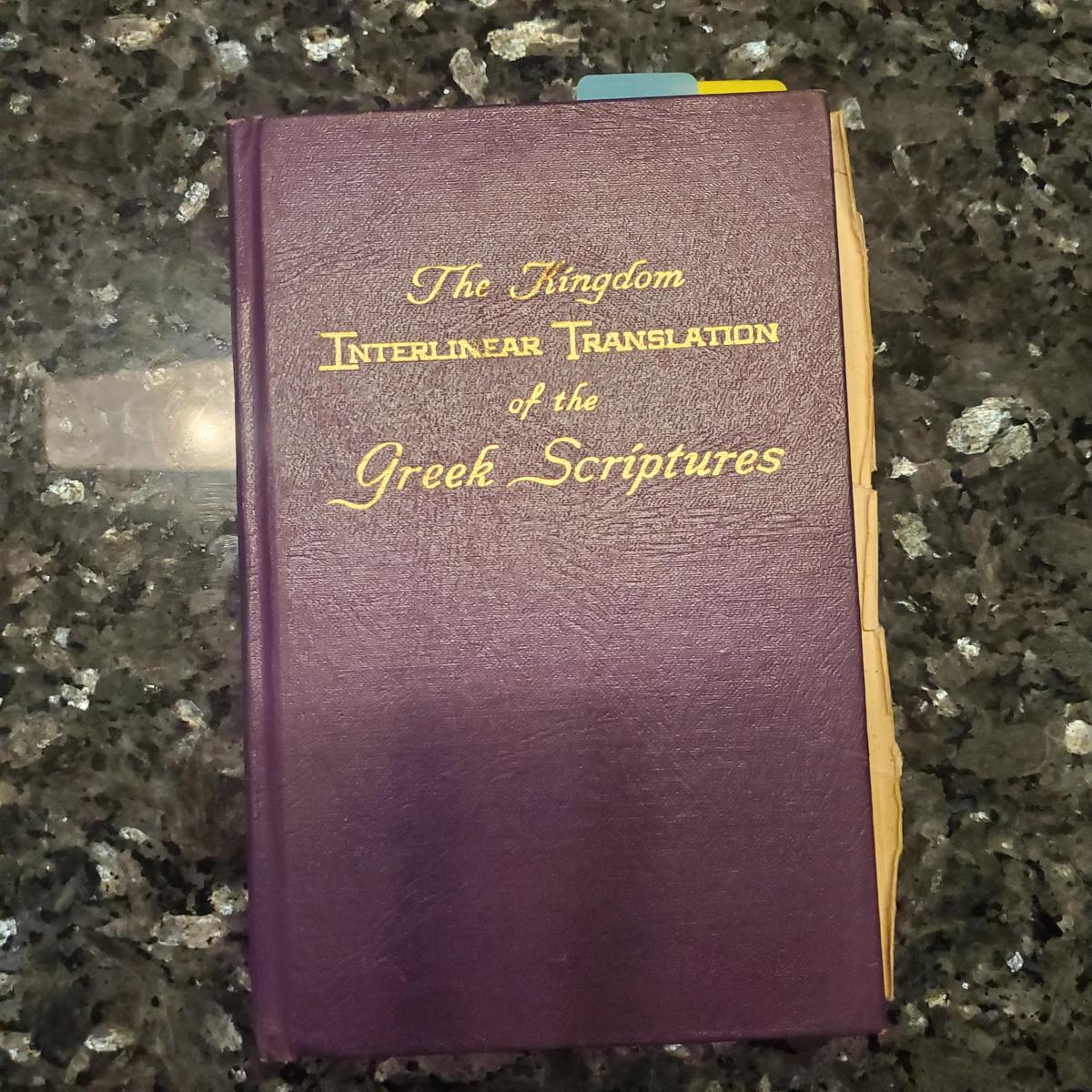
Throughout this page, you'll see photographs from my grandmother's copy of the Kingdom Interlinear Translation — published by the Watchtower Bible and Tract Society in 1969. This book was designed to show readers “what the original koiné Greek basically or literally says.” What you'll discover is that the Watchtower's own interlinear Greek text repeatedly contradicts their New World Translation. These aren't claims from “apostate” sources. This is the Watchtower's own publication exposing the Watchtower's own translation.
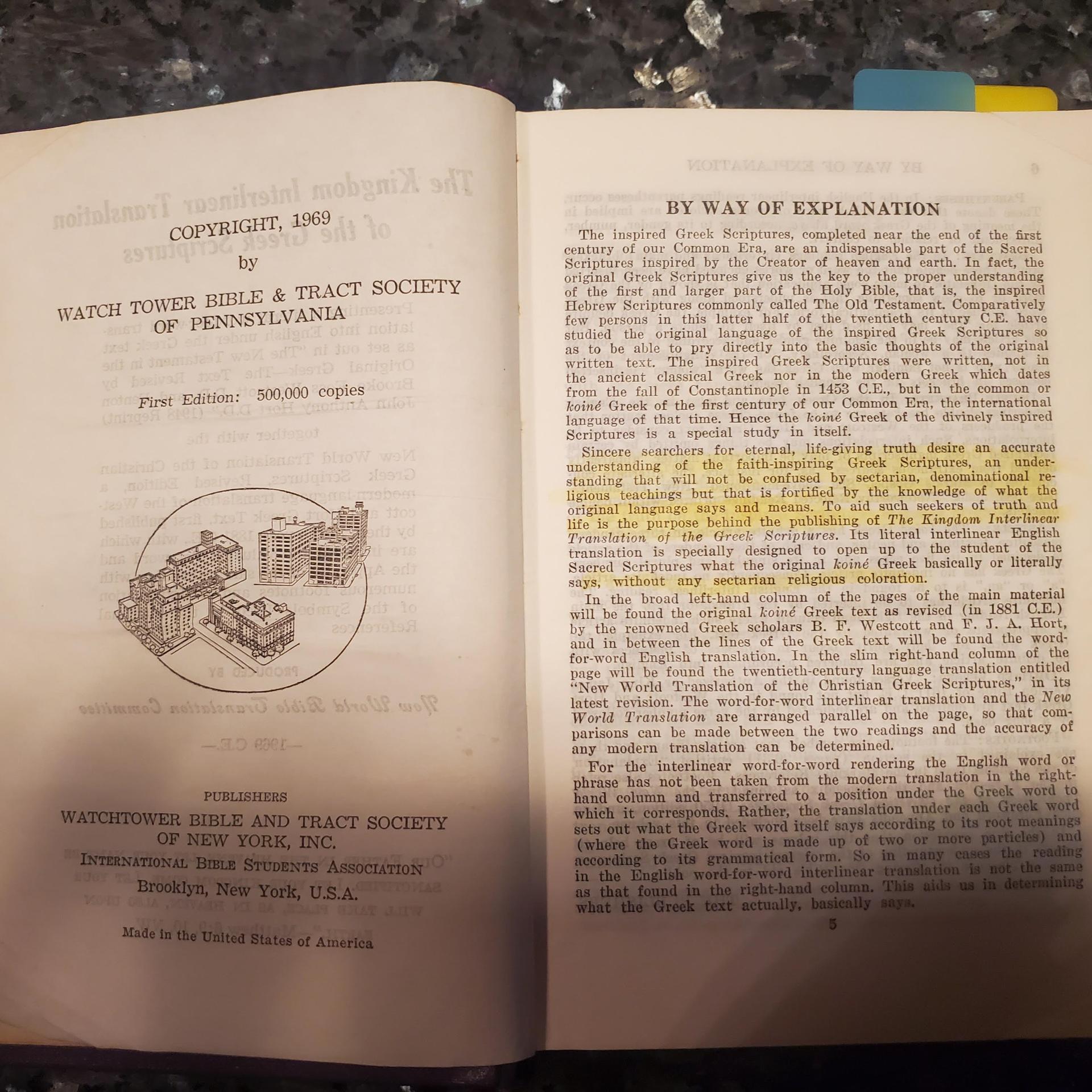
Key Quote from the Introduction:
“Its literal interlinear English translation is specially designed to open up to the student of the Sacred Scriptures what the original koiné Greek basically or literally says, without any sectarian religious coloration.”
Now let's see if the NWT lives up to this promise...
A Solemn Warning from Scripture
Before we examine the evidence, we must understand how seriously God takes the integrity of His Word. From the beginning of Scripture to its end, God has warned against tampering with what He has written.
Deuteronomy 4:2
"You shall not add to the word that I command you, nor take from it, that you may keep the commandments of the LORD your God that I command you."
— Moses to Israel, ~1400 BC
Deuteronomy 12:32
"Everything that I command you, you shall be careful to do. You shall not add to it or take from it."
— Moses to Israel, ~1400 BC
Proverbs 30:5-6
"Every word of God is pure; He is a shield to those who put their trust in Him. Do not add to His words, lest He rebuke you, and you be found a liar."
— Agur son of Jakeh, ~700 BC
Revelation 22:18-19
"I warn everyone who hears the words of the prophecy of this book: if anyone adds to them, God will add to him the plagues described in this book, and if anyone takes away from the words of the book of this prophecy, God will take away his share in the tree of life and in the holy city, which are described in this book."
— Jesus Christ through John, ~95 AD
From Moses to John — spanning over 1,500 years — God's message is consistent and clear:
Do not add to His words. Do not take away from His words.
The consequences include being rebuked, being found a liar, receiving the plagues of Revelation, and losing one's share in the tree of life.
With these warnings in mind, let us examine how the New World Translation handles Scripture — particularly the passages that reveal who Jesus truly is.
What we will show is not a matter of interpretation or translation preference. We will demonstrate, using the Watchtower's own interlinear Bible, that words have been added, meanings have been changed, and the same Greek and Hebrew words have been translated inconsistently — always in ways that obscure the deity of Christ.
Part 1: Worship
The Greek word proskuneo appears 60 times in the New Testament. Jesus receives this worship throughout the Gospels—and never refuses it.
The Watchtower's Translation Promise
"The New World Translation makes every effort to be consistent in its renderings. For a given Hebrew or Greek word, there has been assigned one English word, and this has been used as uniformly as the idiom or context permits."
— Watchtower Online Library, "Advantages of the New World Translation"
What is Proskuneo (προσκυνέω)?
Proskuneo (προσκυνέω) is the primary Greek word for worship in the New Testament. It appears 55 times in the Greek text.
Greek Definition:
"To kiss the hand, bow down before, show obeisance, to worship"
— Strong's G4352
The word literally means to prostrate oneself in reverence. In the New Testament, it's used for worship given to God, to false gods, and—significantly—to Jesus.
The Pattern: One Word, Two Translations
How does the NWT translate "proskuneo"?
When Directed to God, Angels, or Satan
"WORSHIP"
- • Rev 5:14 — elders "worship" God ✓
- • Rev 7:11 — angels "worship" God ✓
- • Rev 19:4 — elders "worship" God ✓
- • Matt 4:9 — Satan asks for "worship" ✓
- • Matt 4:10 — "worship" the Lord your God ✓
- • John 4:20-24 — "worship" the Father ✓
When Directed to Jesus
"OBEISANCE"
- • Matt 2:11 — wise men "do obeisance" ✗
- • Matt 14:33 — disciples "do obeisance" ✗
- • Matt 28:9 — women "do obeisance" ✗
- • Matt 28:17 — disciples "do obeisance" ✗
- • Luke 24:52 — disciples "do obeisance" ✗
- • John 9:38 — blind man "does obeisance" ✗
Same Greek word. Different English translation. The ONLY difference? Who is receiving it.
The Numbers Don't Lie
55
Times proskuneo appears
15
Times directed at Jesus
0
Times NWT translates it "worship" for Jesus
15 times people give proskuneo to Jesus in the New Testament. Zero times does the NWT translate it as "worship." Yet the same word is translated "worship" when given to God, angels, or even Satan.
They Changed Their Own Translation
Hebrews 1:6
"But when he again brings his Firstborn into the inhabited earth, he says: 'And let all God's angels _______ him.'"
NWT 1950-1970:
"WORSHIP"
NWT 1980-Present:
"DO OBEISANCE"
The same Greek word. The same verse. The same translation committee. Why did they change "worship" to "obeisance" in 1980? What changed between 1970 and 1980? Not the Greek text. Only the Watchtower's need to distance Jesus from deity.
Complete Proskuneo Evidence
Here is every instance where Jesus receives proskuneo in the New Testament, with full quotations showing the LSB alongside the NWT rendering.
Matthew 2:2
LSB:
“Where is He who has been born King of the Jews? For we saw His star in the east and have come to worship Him.”
NWT:
“Where is the one born king of the Jews? For we saw his star when we were in the East, and we have come to do him obeisance.”
Matthew 2:11
LSB:
“And after coming into the house they saw the Child with Mary His mother; and they fell to the ground and worshiped Him. Then, opening their treasures, they presented to Him gifts of gold, frankincense, and myrrh.”
NWT:
“And when they went into the house, they saw the young child with Mary its mother, and falling down, they did obeisance to it.”
Matthew 8:2
LSB:
“And behold, a leper came to Him and worshiped Him, saying, ‘Lord, if You are willing, You can make me clean.’”
NWT:
“And look! a leper came up and began doing obeisance to him, saying: ‘Lord, if you just want to, you can make me clean.’”
Matthew 9:18
LSB:
“While He was saying these things to them, behold, a synagogue official came and worshiped Him, saying, ‘My daughter has just died; but come and lay Your hand on her, and she will live.’”
NWT:
“While he was telling them these things, look! a certain ruler who had come did obeisance to him, saying: ‘By now my daughter must be dead; but come and lay your hand on her, and she will come to life.’”
Matthew 14:33
LSB:
“And those who were in the boat worshiped Him, saying, ‘You are truly God's Son!’”
NWT:
“Then those in the boat did obeisance to him, saying: ‘You really are God's Son.’”
Matthew 15:25
LSB:
“But she came and was worshiping Him, saying, ‘Lord, help me!’”
NWT:
“But the woman came and began doing obeisance to him, saying: ‘Lord, help me!’”
Matthew 28:9
LSB:
“And behold, Jesus met them, saying, ‘Rejoice!’ And they came up and took hold of His feet and worshiped Him.”
NWT:
“And look! Jesus met them and said: ‘Good day!’ They approached and took hold of his feet and did obeisance to him.”
Matthew 28:17
LSB:
“And when they saw Him, they worshiped Him; but some doubted.”
NWT:
“And when they saw him, they did obeisance, but some doubted.”
Luke 24:52
LSB:
“And they, after worshiping Him, returned to Jerusalem with great joy.”
NWT:
“And they did obeisance to him and returned to Jerusalem with great joy.”
John 9:38
LSB:
“And he said, ‘Lord, I believe.’ And he worshiped Him.”
NWT:
“He said: ‘I do put my faith in him, Lord.’ And he did obeisance to him.”
Hebrews 1:6
LSB:
“And when He again brings the firstborn into the world, He says, ‘And let all the angels of God worship Him.’”
NWT (current):
“But when he again brings his Firstborn into the inhabited earth, he says: ‘And let all of God's angels do obeisance to him.’”
Note: The NWT translated this as “worship” from 1950–1970, then changed it to “obeisance” in 1980!
Jesus Never Refused Proskuneo
When people offered proskuneo to angels, what happened?
"I fell down to worship [proskuneo] at the feet of the angel... But he said to me, 'Do not do that! I am a fellow servant... Worship God!'"
— Revelation 22:8-9
Angels refuse proskuneo and redirect it to God. But Jesus never refused it. Not once.
When people offered proskuneo to Peter, what happened?
"When Peter entered, Cornelius met him and fell down at his feet and worshiped him. But Peter lifted him up, saying, 'Stand up; I too am just a man.'"
— Acts 10:25-26
The Evidence
- Proskuneo appears 55 times in the New Testament
- 15 times it's directed at Jesus
- NWT translates it "worship" for God, angels, even Satan
- NWT translates it "obeisance" 100% of the time for Jesus
- They even changed Hebrews 1:6 from "worship" to "obeisance" in 1980
- Angels and Peter refused proskuneo—Jesus never did
- This violates their own stated translation principle
Ask Any JW:
"The Watchtower claims they translate each Greek word consistently. Why is proskuneo translated 'worship' when given to God or Satan, but 'obeisance' when given to Jesus?"
"And why did the NWT say angels should 'worship' Jesus in Hebrews 1:6 from 1950-1970, but changed it to 'obeisance' in 1980?"
Part 2: Hebrews 1
The Father calls the Son “God” and “Lord,” applies YHWH's words to Him, and commands angels to worship Him.
Hebrews 1: Verse-by-Verse Analysis
Why This Chapter Destroys JW Theology
Hebrews 1 isn't just one verse that can be explained away. It's a systematic theological argument written by a first-century Jewish believer who was steeped in the Old Testament. The entire chapter is God the Father making declarations about God the Son.
Every sentence presents a problem for the Watchtower's theology. Read them together, and it becomes impossible to claim Jesus is a created being.
Hebrews 1:1-2 - God Has Spoken Through His Son
LSB:
"Long ago, at many times and in many ways, God spoke to our fathers by the prophets, but in these last days he has spoken to us by his Son, whom he appointed the heir of all things, through whom also he created the world."
Key Phrase #1: "Heir of All Things"
The Son is appointed heir of all things (τῶν πάντων - ton panton). Not "most things." Not "some things." Everything that exists belongs to the Son. Only God owns everything.
Key Phrase #2: "Through Whom He Created the World"
Greek: δι' οὗ καὶ ἐποίησεν τοὺς αἰῶνας (di' hou kai epoiesen tous aionas)
"Through whom he made the ages/worlds." The Son is the active agent of creation. Genesis 1:1 says "God created." Hebrews 1:2 says God created through the Son. Either the Son is God, or there are two creators.
The JW Problem:
If Jesus is a created being, then this verse says God created the world through a created being. But that means creation was made through someone who is part of creation. That's logically impossible. The Creator must exist outside of creation.
Hebrews 1:3 - The Radiance of God's Glory
LSB:
"He is the radiance of the glory of God and the exact imprint of his nature, and he upholds the universe by the word of his power. After making purification for sins, he sat down at the right hand of the Majesty on high..."
"The Radiance of the Glory of God"
Greek: ἀπαύγασμα τῆς δόξης (apaugasma tes doxes)
The word "radiance" (apaugasma) means the brightness that emanates from a light source. You can't separate light from its radiance. If God's glory exists, its radiance exists. The Son is not a reflection—He IS the radiance. This indicates same nature, not created similarity.
"The Exact Imprint of His Nature"
Greek: χαρακτὴρ τῆς ὑποστάσεως αὐτοῦ (character tes hypostaseos autou)
"Character" (χαρακτήρ) means an exact reproduction—like a stamp making an impression in wax. "Hypostasis" (ὑπόστασις) means being, substance, or nature. The Son is the exact imprint of God's very being.
Not "similar to God's nature." Not "representing God's nature." The EXACT imprint. An exact imprint has the same nature as the original. A wax seal has the exact image of the stamp.
"Upholds the Universe by the Word of His Power"
Greek: φέρων τε τὰ πάντα τῷ ῥήματι τῆς δυνάμεως αὐτοῦ
"Bearing/carrying all things by the word of his power." Present tense—He is actively sustaining the universe right now. Not "helping God sustain it." Not "channeling God's power." His power.
Colossians 1:17 says the same thing: "In him all things hold together." If Jesus stopped sustaining creation for one second, the universe would collapse. Can a created being do this?
Ask Yourself:
Could Michael the Archangel be "the radiance of God's glory"? Could an angel be "the exact imprint of God's nature"? Could a created being uphold the universe by his own power? If you answered no to any of these, then Jesus cannot be a created being.
Hebrews 1:4-5 - Superior to Angels
LSB:
"...having become as much superior to angels as the name he has inherited is more excellent than theirs. For to which of the angels did God ever say, 'You are my Son, today I have begotten you'? Or again, 'I will be to him a father, and he shall be to me a son'?"
The JW Dilemma:
The Watchtower teaches that Jesus IS Michael the Archangel. But Hebrews 1:4-5 explicitly says Jesus is superior to angels. The Greek word is κρείττων (kreitton) - better, stronger, more excellent.
Question: How can Jesus be superior to angels if He IS an angel? That's like saying "Bob is superior to humans" when Bob is a human. It makes no sense.
"You Are My Son"
This quotes Psalm 2:7, a Messianic psalm. The question is rhetorical: "To which angel did God ever say this?" Answer: None. Because no angel has the unique Father-Son relationship that Jesus has with God. This relationship is exclusive to deity.
Hebrews 1:6 - The Father Commands Angels to Worship the Son
LSB:
"And again, when he brings the firstborn into the world, he says, 'Let all God's angels worship him.'"
Greek Text:
προσκυνησάτωσαν αὐτῷ πάντες ἄγγελοι θεοῦ
(proskunesatosan auto pantes angeloi theou)
"Let worship him all angels of God"
NWT Translation:
"But when he again brings his Firstborn into the inhabited earth, he says: 'And let all of God's angels do obeisance to him.'"
The Word: Proskuneo
Same word used throughout Revelation for worshiping God. Same word angels refuse when John tries to worship them (Rev 19:10, 22:8-9). The Father is commanding angels to give Jesus the same proskuneo that belongs to God alone.
The Quote Source:
This quotes from Deuteronomy 32:43 (Septuagint) or Psalm 97:7. Both passages are about worshiping YHWH. The writer of Hebrews applies a command to worship YHWH directly to Jesus.
The Inescapable Logic:
- Angels are commanded to worship (proskuneo) Jesus
- Angels refuse proskuneo from humans because only God should receive it
- The Father would never command angels to commit idolatry
- Therefore: Jesus must be God
Hebrews 1:7-8 - Angels vs. The Son
LSB:
"Of the angels he says, 'He makes his angels winds, and his ministers a flame of fire.' But of the Son he says, 'Your throne, O God, is forever and ever, the scepter of uprightness is the scepter of your kingdom.'"
The Contrast:
Of angels: They are created servants, made into winds and fire (from Psalm 104:4)
But of the Son: "Your throne, O God..." The Father addresses the Son as God.
The Greek Grammar:
ὁ θρόνος σου ὁ θεός (ho thronos sou ho theos)
"ὁ θεός" (ho theos) is in the vocative case - a direct address. Like saying "O God" or "God" when speaking directly to someone. This is God the Father speaking TO the Son, calling Him "O God."
The NWT tries to change this to "God is your throne" to avoid calling Jesus "God." But this is grammatically impossible and makes no sense. A throne is a seat, not a person. How can God be a throne?
Every Other Translation:
• KJV: "But unto the Son he saith, Thy throne, O God..."
• NIV: "But about the Son he says, 'Your throne, O God..."
• NASB: "But of the Son He says, 'Your throne, O God..."
• LSB: "But of the Son he says, 'Your throne, O God..."
Hundreds of translations. Dozens of languages. Across 2000 years. All say "O God" except the NWT.
The Source:
This quotes Psalm 45:6-7, a wedding psalm about the king. But the writer of Hebrews applies it to Jesus and has the Father calling Him "God." If this psalm was just about a human king, why does the Father use it to address the Son as God?
Hebrews 1:9 - Anointed Above His Companions
LSB:
"You have loved righteousness and hated wickedness; therefore God, your God, has anointed you with the oil of gladness beyond your companions."
Notice:
After calling the Son "O God" in v8, the Father continues speaking TO the Son and says "God, your God, has anointed you."
This shows the divine and human natures of Christ. As God, He has a throne forever (v8). As the incarnate Son, He has "God, your God" (v9) - referring to His relationship with the Father during His earthly ministry. Two natures, one person.
Hebrews 1:10-12 - The Son as Creator and Eternal
LSB:
“And, ‘You, Lord, laid the foundation of the earth in the beginning, and the heavens are the work of your hands; they will perish, but you remain; they will all wear out like a garment, like a robe you will roll them up, like a garment they will be changed. But you are the same, and your years will have no end.’”
The Devastating Truth:
This quotes Psalm 102:25-27 - a psalm about YHWH creating the heavens and earth. The Father is quoting this psalm and applying it directly to the Son.
The Father is saying: "Son, YOU laid the foundation of the earth. YOU made the heavens." Either Jesus is YHWH, or there are two creators. The Bible allows for only one.
"You Are the Same"
Greek: σὺ δὲ ὁ αὐτὸς εἶ (su de ho autos ei) - "You are the same"
This speaks of immutability - God does not change. Malachi 3:6 says "I the LORD do not change." James 1:17 says God has "no variation or shadow due to change." The Father says the Son has this same attribute - He is immutable, unchanging.
"Your Years Will Have No End"
The Son is eternal. No beginning, no end. "Your years" - not "the years Jehovah gave you" or "the years since you were created." Your years - eternally His own.
A created being by definition has a beginning. The Father says the Son's years have no end. If His years have no end, they also have no beginning. He is eternal.
The Logical Conclusion:
- The Son laid the foundation of the earth
- The Son made the heavens
- The Son remains while creation perishes
- The Son is unchanging
- The Son's years have no end
Can any of this be said about a created being? Or must the Son be the eternal Creator—God Himself?
Hebrews 1:13 - No Angel Ever Received This Promise
LSB:
"And to which of the angels has he ever said, 'Sit at my right hand until I make your enemies a footstool for your feet'?"
This quotes Psalm 110:1 - the most quoted OT verse in the NT. It's about YHWH speaking to the Messiah. The right hand of God is the position of ultimate authority and power. No angel, no created being, sits at God's right hand sharing His throne.
The question is rhetorical: "To which angel has God said this?" None. Because no angel shares God's throne. Only the Son does, because He is God.
Read Hebrews 1 in Any Bible Except the NWT
Verse 2: The Son created all things
Verse 3: The Son is the exact imprint of God's nature and upholds the universe
Verse 4: The Son is superior to angels
Verse 6: Angels are commanded to worship the Son
Verse 8: The Father calls the Son "O God" and says His throne is forever
Verse 10: The Father says the Son laid the foundation of the earth
Verse 12: The Father says the Son is unchanging and eternal
Verse 13: The Son sits at God's right hand—no angel ever received this honor
Now Answer This Question:
Could any of this be said about Michael the Archangel?
This isn't one verse taken out of context. This is thirteen verses where God the Father systematically declares who the Son is. And every declaration points to the same conclusion: The Son is God.
Part 3: Isaiah 9:6
700 years before Jesus was born, Isaiah prophesied that the Messiah would be called “Mighty God” and “Everlasting Father.”
Isaiah 9:6: The Messiah Called "Mighty God"
Why This Verse Is Ignored by the Watchtower
Most Jehovah's Witnesses don't know this verse well. It's not emphasized in Watchtower publications.
Why? Because Isaiah 9:6 is one of the clearest Old Testament declarations that the Messiah would be God Himself in human flesh.
The Prophecy
Isaiah 9:6 (LSB):
"For to us a child is born, to us a son is given; and the government shall be upon his shoulder, and his name shall be called Wonderful Counselor, Mighty God, Everlasting Father, Prince of Peace."
Mighty God (אֵל גִּבּוֹר - El Gibbor)
The Hebrew:
אֵל (El) - God
גִּבּוֹר (Gibbor) - Mighty, strong
Together: El Gibbor = The Mighty God
The Watchtower Says:
"Jesus is 'Mighty God' (lowercase) but Jehovah is 'Almighty God.' Jesus is a mighty god, but not the Almighty."
This falls apart when you see how El Gibbor is used elsewhere.
Every Other Use of "El Gibbor":
Isaiah 10:21 (LSB)
“A remnant will return, the remnant of Jacob, to the Mighty God.”
This refers to YHWH. The remnant returns to the Mighty God — YHWH.
Jeremiah 32:18 (LSB)
“Who shows lovingkindness to thousands, but repays the iniquity of fathers into the bosom of their children after them, O great and mighty God, Yahweh of hosts is His name.”
El Gibbor is explicitly connected to Yahweh of hosts by name.
Deuteronomy 10:17 (LSB)
“For Yahweh your God is the God of gods and the Lord of lords, the great, the mighty, and the awesome God who does not show partiality nor take a bribe.”
Yahweh is “the great El, the Gibbor.”
Nehemiah 9:32 (LSB)
“Now therefore, our God, the great, the mighty, and the awesome God, who keeps covenant and lovingkindness, do not let all the hardship seem insignificant before You, which has come upon us, our kings, our princes, our priests, our prophets, our fathers, and on all Your people, from the days of the kings of Assyria to this day.”
A prayer addressing Yahweh as “our God, the El Gibbor.”
The Inescapable Logic:
- Isaiah 9:6 calls the Messiah "El Gibbor"
- Isaiah 10:21 uses "El Gibbor" for YHWH
- Jeremiah 32:18 connects "El Gibbor" with YHWH's name
- Deuteronomy 10:17 calls YHWH "the great El, the Gibbor"
- Nehemiah 9:32 addresses YHWH as "El Gibbor"
There Are Only Two Options:
Option 1:
"El Gibbor" can apply to created beings. But then YHWH is also "a mighty god" (lowercase). This is polytheism.
Option 2:
"El Gibbor" belongs exclusively to YHWH. Therefore, the Messiah is YHWH Himself.
The Watchtower's explanation doesn't work. The Hebrew proves it.
The Evidence Is Overwhelming
Ask Any Jehovah's Witness:
"If El Gibbor in Isaiah 9:6 means Jesus is 'a mighty god' (created), then what does El Gibbor mean in Isaiah 10:21 and Jeremiah 32:18 when it refers to YHWH?"
They won't have an answer. The Hebrew proves Jesus is YHWH.
Part 4: John 8:58
Jesus claims the divine name “I AM” from Exodus 3:14. The Watchtower's own Kingdom Interlinear exposes their mistranslation.
John 8:58: "Before Abraham Was, I AM"
Remember Their Promise?
"The New World Translation makes every effort to be consistent in its renderings. For a given Hebrew or Greek word, there has been assigned one English word, and this has been used as uniformly as the idiom or context permits."
— Watchtower Online Library, "Advantages of the New World Translation"
We saw how they broke this promise with proskuneo (worship vs. obeisance). Now watch them do something even more deceptive — they obscure both ends of the connection between Exodus 3:14 and John 8:58, and they add words that aren't even in the original Hebrew.
The Hebrew of Exodus 3:14: Word by Word
Hebrew Text:
אֶהְיֶה אֲשֶׁר אֶהְיֶה
Ehyeh Asher Ehyeh
אֶהְיֶה (Ehyeh) — "I am" or "I will be"
First person singular of the verb הָיָה (hayah) = "to be"
אֲשֶׁר (Asher) — "who" or "what" or "that"
A relative pronoun — nothing more
אֶהְיֶה (Ehyeh) — "I am" or "I will be"
Same word repeated
That's it. Three words. The Hebrew contains:
- No word for "prove" (Hebrew: נָסָה — nasa)
- No word for "choose" (Hebrew: בָּחַר — bachar)
- No word for "become" (Hebrew: הָיָה can mean this, but see below)
How Translations Render Exodus 3:14
Most English Translations:
"I AM WHO I AM"
"Say to the Israelites: 'I AM has sent me to you.'"
— ESV, NIV, NASB, KJV, NKJV, CSB, etc.
Some Jewish Translations:
"I WILL BE WHAT I WILL BE"
— JPS, some rabbinical sources
Note: Even this rendering has just three concepts — no added words.
NWT (1984):
"I SHALL PROVE TO BE WHAT I SHALL PROVE TO BE"
Added: "PROVE TO BE" (4 extra words!)
NWT (2013 — Current):
"I Will Become What I Choose to Become"
Added: "CHOOSE" — a word that doesn't exist in the Hebrew!
Where did "choose" come from?
The Hebrew word for "choose" is בָּחַר (bachar). It does not appear anywhere in Exodus 3:14. The NWT translators simply invented this addition. Even the NWT footnote admits the literal Hebrew is just "I Will Become What I Will Become" — so where did "Choose" come from?
What Greek-Speaking Jews Actually Used
The Septuagint (LXX) was the Greek translation of the Hebrew Bible made by Jewish scholars around 200 BC. This is what Greek-speaking Jews in Jesus' day read and heard.
Septuagint (LXX) of Exodus 3:14:
ἐγώ εἰμι ὁ ὤν
(ego eimi ho on) = "I am the Being" / "I am the Existing One"
Even the NWT's own footnote admits:
"Gr., E·goʹ ei·mi ho on, 'I am The Being,' or, 'I am The Existing One'"
So they know the Greek says ego eimi — "I am" — yet they still translate the Hebrew as "I Will Become What I Choose to Become"!
What Jesus Said: John 8:58
Greek Text:
πρὶν Ἀβραὰμ γενέσθαι ἐγὼ εἰμί
(prin Abraam genesthai ego eimi)
Word-for-word: "Before Abraham to become, I am"
Most Translations:
"Before Abraham was, I am."
Present tense — matching the Greek exactly
NWT:
"Before Abraham came into existence, I have been."
Changed from present tense to perfect tense!
The Double Cover-Up: Obscuring Both Ends
Watch what the NWT does to completely sever the connection between God's name in Exodus and Jesus' claim in John:
In Most Bibles
Exodus 3:14:
"I AM has sent me to you"
John 8:58:
"Before Abraham was, I am"
Clear connection!
In the NWT
Exodus 3:14:
"I Will Become" (+ "choose"!)
John 8:58:
"I have been"
Connection destroyed!
Exodus 3:14: "I AM" → "I Will Become What I Choose" (future + added word)
John 8:58: "I am" → "I have been" (changed to past/perfect)
They moved both verses away from the present tense — in opposite directions — AND added a word that doesn't exist in the Hebrew!
My Grandmother's Kingdom Interlinear Proves It
The Watchtower's own Greek-English interlinear shows the truth. First, look at John 8:18 — just two pages before John 8:58:
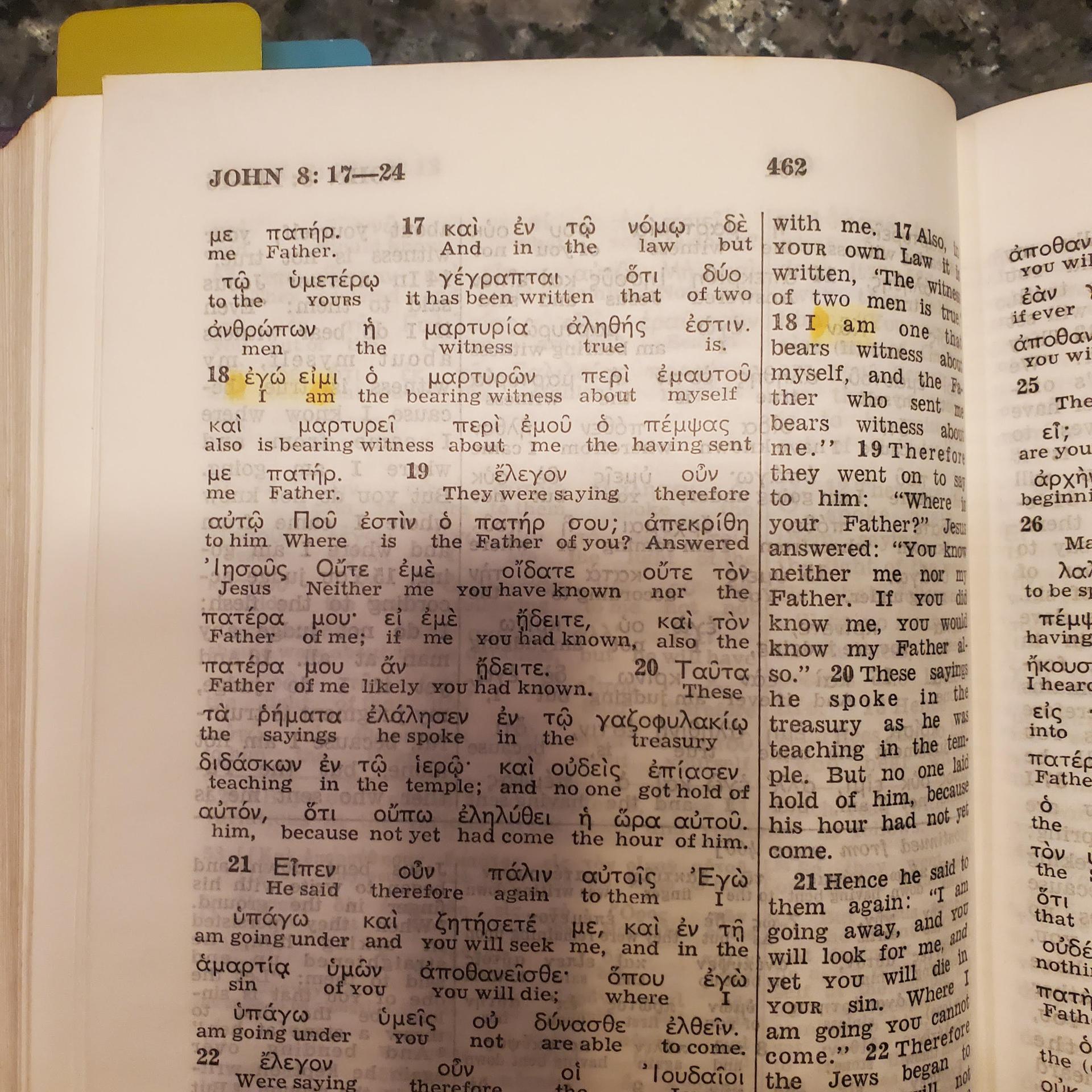
John 8:18 — “I am” (Correct Translation)
The Greek “ἐγώ εἰμι” (ego eimi) is correctly translated “I am” in both the interlinear AND the NWT. Keep this in mind as we look at John 8:58, just two pages later...
Now look at John 8:58 — the exact same Greek phrase, but watch what happens:
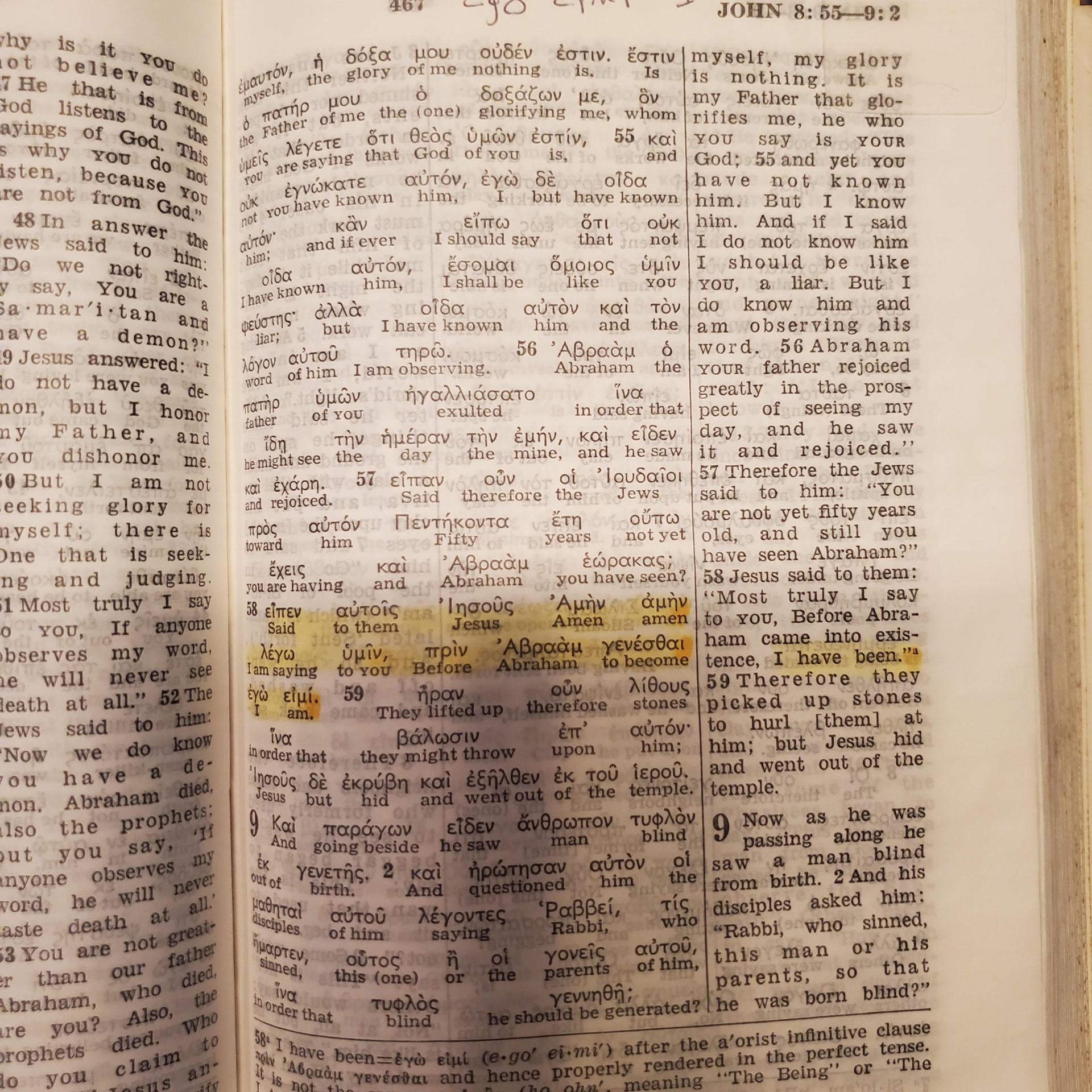
John 8:58 — Same Greek, Different Translation
The exact same Greek phrase “ἐγώ εἰμι” (ego eimi) that was correctly translated “I am” in verse 18 is now rendered “I have been” in the NWT. Same words. Same book. Same chapter. Different translation.
Greek:
ἐγὼ εἰμί
Interlinear (word-for-word):
“I am”
NWT Column:
“I have been”
Why the Change?
Because in this context, Jesus is clearly claiming the divine name from Exodus 3:14 — and the Jews picked up stones to kill Him for blasphemy. Their own interlinear shows “I am” as the literal translation. Then the NWT column changes it. They know what the Greek says — they just don't want you to see it.
The Pattern: Ego Eimi Throughout John
The phrase ἐγώ εἰμι (ego eimi) appears multiple times in John's Gospel. Watch how the NWT translates it:
ONLY VERSE WHERE THEY CHANGE THE TENSE
Same Greek phrase. Same author. Same Gospel.
Why is John 8:58 the ONLY verse where they changed the tense?
The Jews Understood Exactly What He Said
John 8:59 (immediately after):
"So they picked up stones to throw at him, but Jesus hid himself and went out of the temple."
Why did they try to stone Him?
Under Jewish law, the penalty for blasphemy was death by stoning (Leviticus 24:16). The Jews understood that Jesus was claiming to be YHWH — the eternal "I AM" of Exodus 3:14.
If Jesus merely meant "I existed before Abraham," that wouldn't be blasphemy. Angels existed before Abraham. The Jews wouldn't stone someone for claiming to be old. They tried to stone Him because He claimed to be God.
The Evidence
- Hebrew of Exodus 3:14 is just 3 words: "I am/will be" + "who/what" + "I am/will be"
- NWT adds "choose" — a word not in the Hebrew (בָּחַר doesn't appear)
- Greek Septuagint says "ego eimi" — "I am" — even NWT footnote admits this
- NWT changed Exodus 3:14 from "I AM" to "I Will Become What I Choose"
- NWT changed John 8:58 from "I am" to "I have been"
- Both changes move away from present tense — in opposite directions
- Kingdom Interlinear shows "I am" in the word-for-word column
- NWT translates ego eimi correctly everywhere else in John
- The Jews tried to stone Jesus for blasphemy — they understood His claim
Ask Any JW:
"The Hebrew of Exodus 3:14 has three words. Where does the word 'choose' come from in 'I Will Become What I Choose to Become'?"
"The NWT footnote admits the Greek Septuagint says 'ego eimi' — 'I am.' Why does the NWT change it to 'I Will Become' in Exodus, and 'I have been' in John 8:58?"
"Isn't it convenient that all these changes work together to hide the connection between God's name and Jesus' claim?"
Part 5: John 1:1
The most famous NWT mistranslation — “a god” instead of “God.” Their own “article rule” collapses under scrutiny.
John 1:1 — "The Word Was God" vs "The Word Was a god"
Greek Text (from the Kingdom Interlinear):
Ἐν ἀρχῇ ἦν ὁ λόγος, καὶ ὁ λόγος ἦν πρὸς τὸν θεόν, καὶ θεὸς ἦν ὁ λόγος.
En archē ēn ho logos, kai ho logos ēn pros ton theon, kai theos ēn ho logos.
Kingdom Interlinear — Word-for-Word:
"In beginning was the Word, and the Word was toward the God, and god was the Word."
New World Translation:
"In [the] beginning the Word was, and the Word was with God, and the Word was a god."
The Watchtower's Argument:
The Watchtower claims that because there is no definite article (“the”) before “theos” (God) in the third clause, it should be translated as “a god” — an indefinite noun referring to a lesser divine being.
But does the Watchtower apply this rule consistently?
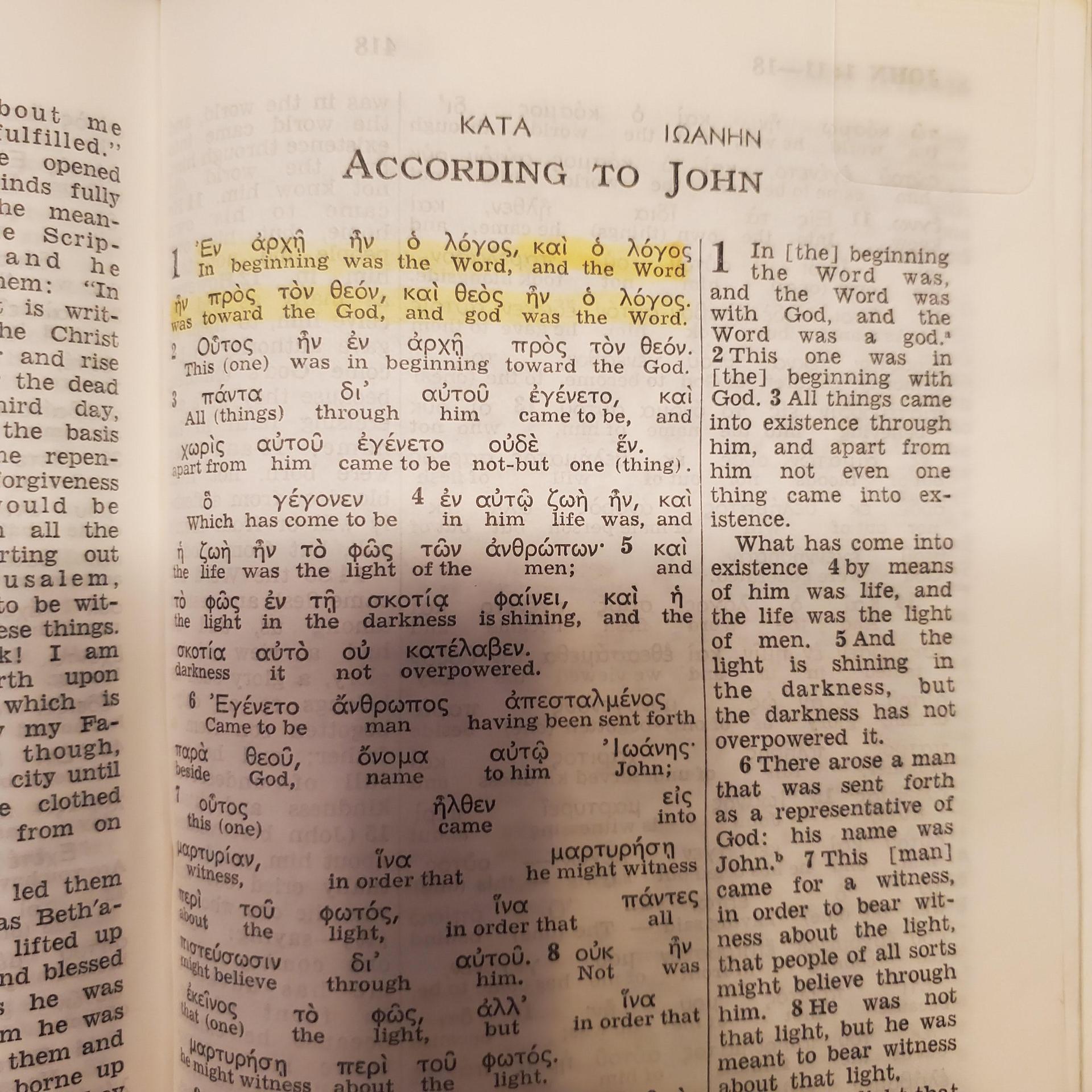
John 1:1 in the Kingdom Interlinear Translation
The interlinear clearly shows “god was the Word.” There is no indefinite article “a” in the Greek text. Yet the NWT renders it “the Word was a god.”
John 1:18 — The Double Standard in One Verse
John 1:18 contains the word "theos" (God) twice. Neither occurrence has the definite article. Watch what the NWT does:
NWT John 1:18:
"No man has seen God at any time; the only-begotten god who is in the bosom [position] with the Father is the one that has explained him."
First "theos":
No article → translated "God" (capital)
Refers to the Father
Second "theos":
No article → translated "god" (lowercase)
Refers to Jesus
Same word. Same grammatical construction. Different translation. The only difference? One refers to Jesus.
Why They Didn't Add "[Other]" Here
Remember how the NWT adds "[other]" four times in Colossians 1:16-17 to make Jesus a created being? They didn't dare do that in John 1:3:
NWT John 1:3:
"All things came into existence through him, and apart from him not even one thing came into existence."
If Jesus is a created being, He would be one of the "things" that came into existence. But John says "not even one thing" came into existence apart from Him.
Jesus is not one of the "things" created. He is the Creator Himself.
Questions to Consider
- •If the "article rule" is a valid principle of Greek grammar, why doesn't the NWT apply it consistently?
- •Why does John 1:6 use "God" (capital) without the article, but John 1:1 uses "god" (lowercase) also without the article?
- •Why would the Watchtower use Dr. Westcott's Greek text but ignore his interpretation of it?
- •If "not even one thing" came into existence apart from Jesus, how can Jesus Himself be a created thing?
- •The Watchtower promised "one meaning per word." Why does "theos" get translated "God" or "god" depending on whether it refers to Jesus?
Remember the Watchtower's Promise:
"To each major word we have assigned one meaning and have held to that meaning."
— Kingdom Interlinear Translation, 1985 Edition, Page 9
The word "theos" is translated "God" when referring to the Father, but "god" when referring to Jesus. Same word. Different meanings. Broken promise.
Part 6: Colossians 1:15-17
The NWT adds the word “[other]” four times to make Jesus a created being. But it's not in the Greek text.
Colossians 1:15-17: Firstborn or Creator?
How the NWT Adds "[Other]" Four Times
The Watchtower adds the word "other" four times to make Jesus a created being instead of the Creator. But it's not in the Greek text.
The Original Text
Colossians 1:16 (LSB):
"For by him all things were created, in heaven and on earth, visible and invisible, whether thrones or dominions or rulers or authorities—all things were created through him and for him."
Colossians 1:16 (NWT):
"because by means of him all [other] things were created in the heavens and on the earth, the things visible and the things invisible... All [other] things have been created through him and for him."
Notice the word "[other]" in brackets? It's not in the Greek.
Why This Matters
Without "[other]":
Jesus created ALL things → He cannot be created
With "[other]":
Jesus created all OTHER things → He was created first, then created everything else
By adding “[other]” four times in verses 16–17, the NWT completely changes the meaning from Jesus being the eternal Creator to Jesus being the first creation.
Colossians 1:17 — The Same Pattern
The NWT doesn't stop at verse 16. They add “[other]” to verse 17 as well:
Colossians 1:17 (LSB):
“And He is before all things, and in Him all things hold together.”
Colossians 1:17 (NWT):
“Also, he is before all [other] things, and by means of him all [other] things were made to exist.”
Once again, “[other]” is not in any Greek manuscript. Without it, the verse declares Jesus exists before all things and holds all things together — a role only God can fill.
The Greek Doesn't Say “Other”
Greek word used:
πάντα (panta) = “all things”
NOT πάντα τὰ ἄλλα (panta ta alla) = “all the other things”
If Paul wanted to say “all other things,” he knew how to write it in Greek. He deliberately wrote “all things” (panta) without any qualifier.
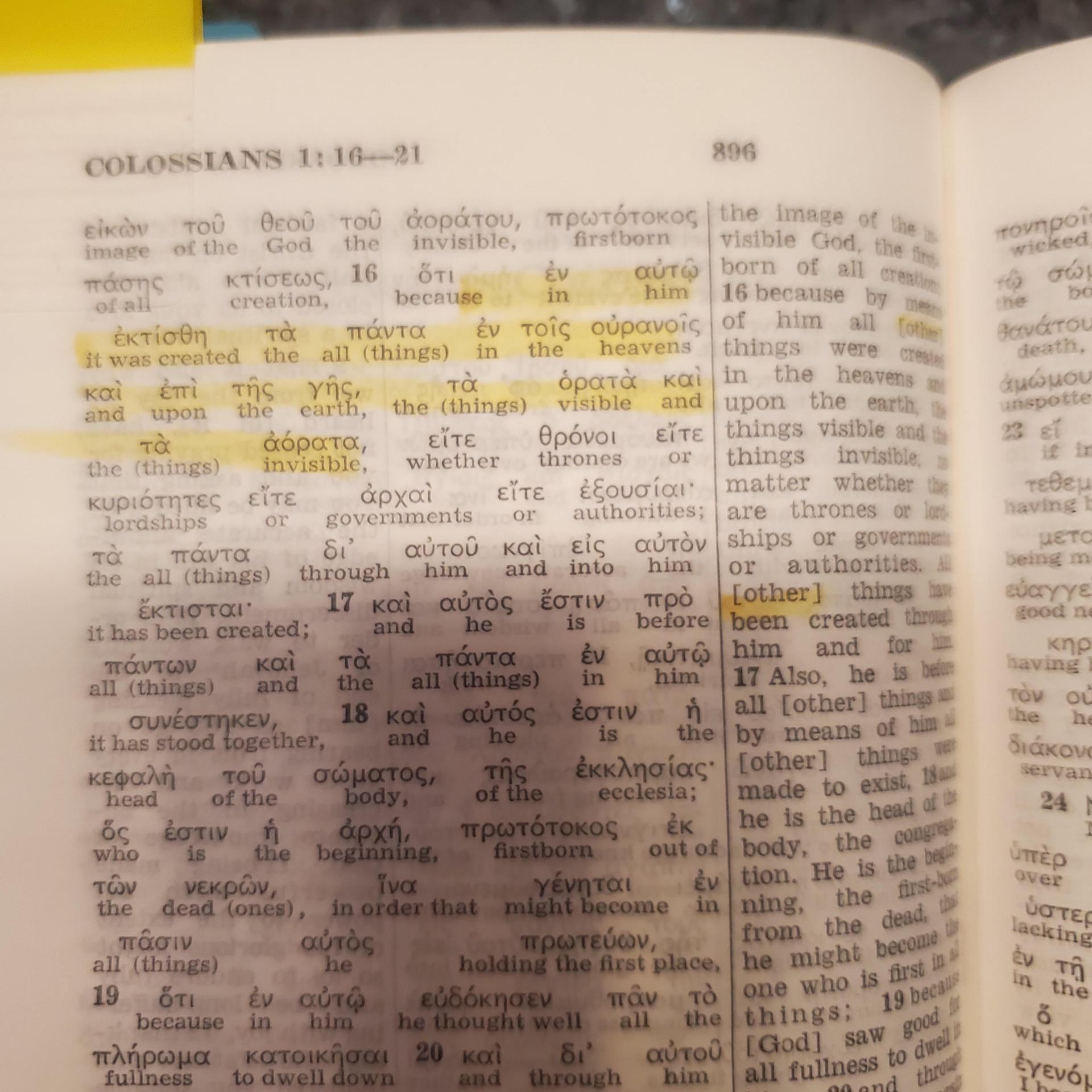
Colossians 1:16-17 in the Kingdom Interlinear
The Greek says “the all things” (τὰ πάντα / ta panta) were created through Christ. There is no Greek word for “other.” Yet the NWT inserts “[other]” four times to make it appear Jesus is part of creation rather than the Creator. Even their own brackets admit these words were added.
"Firstborn" Doesn't Mean First Created
Colossians 1:15:
"He is the image of the invisible God, the firstborn of all creation."
“Firstborn” = Preeminence, not first created
In Jewish culture, “firstborn” meant rank and privilege, not chronological order.
Psalm 89:27 (LSB)
“I also shall make him My firstborn, the highest of the kings of the earth.”
David was Jesse's youngest son (1 Samuel 16:11), yet God calls him “firstborn” — demonstrating that “firstborn” means preeminence and rank, not birth order.
The Evidence
- Greek says "all things" (panta), not "all other things"
- NWT adds "[other]" four times - not in any Greek manuscript
- If Jesus created ALL things, He cannot be created
- "Firstborn" means preeminent, not first created (see Psalm 89:27)
- Verse 17: "He is before all things" - existed before creation
Ask Any JW:
"Where is the word 'other' in the Greek text of Colossians 1:16? Why does the NWT add it in brackets?"
Part 7: Alpha and Omega
In Revelation, both the Father and Jesus claim the title “Alpha and Omega”— a title that belongs to God alone.
Revelation: Alpha and Omega
The Same Title Applied to Both God and Jesus
In Revelation, the title "Alpha and Omega" is used by both God the Father and Jesus Christ— showing they share the same divine nature.
God the Father: Alpha and Omega
Revelation 1:8:
"I am the Alpha and the Omega," says the Lord God, "who is and who was and who is to come, the Almighty."
Clearly God the Father speaking
Revelation 21:6-7:
"I am the Alpha and the Omega, the beginning and the end... I will be his God and he will be my son."
Again, clearly the Father (mentions "my son")
Jesus Christ: Alpha and Omega
Revelation 22:12-13, 16:
"Behold, I am coming soon... I am the Alpha and the Omega, the first and the last, the beginning and the end... I, Jesus, have sent my angel to testify to you about these things."
Jesus explicitly identifies Himself as the speaker
Revelation 1:17-18:
"I am the first and the last, and the living one. I died, and behold I am alive forevermore..."
Only Jesus died and rose again—same title as "Alpha and Omega"
The Connection to Isaiah
Isaiah 44:6 (LSB):
“Thus says Yahweh, the King of Israel and his Redeemer, Yahweh of hosts: ‘I am the first, and I am the last, and there is no God besides Me.’”
Isaiah 48:12 (LSB):
“Listen to Me, O Jacob, even Israel whom I called; I am He, I am the first, I am also the last.”
In Isaiah, "first and last" is exclusively used by YHWH. In Revelation, Jesus claims this same title—identifying Himself as YHWH.
The Parallel Titles
God the Father
- ✓ Alpha and Omega (1:8)
- ✓ Beginning and End (21:6)
- ✓ Who is to come (1:8)
- ✓ The Almighty (1:8)
Jesus Christ
- ✓ Alpha and Omega (22:13)
- ✓ Beginning and End (22:13)
- ✓ Coming soon (22:12)
- ✓ First and Last (1:17)
These are not two different beings—they share the same divine titles
The Evidence
- Father called "Alpha and Omega" in Rev 1:8 and 21:6
- Jesus called "Alpha and Omega" in Rev 22:13
- "First and Last" is YHWH's title in Isaiah 44:6 and 48:12
- Jesus claims "First and Last" in Rev 1:17 and 22:13
- Same divine titles = same divine nature
Ask Any JW:
"If 'Alpha and Omega' is God's unique title, why does Jesus use it for Himself in Revelation 22:13?"
Part 8: “My Lord and My God”
Thomas calls Jesus “my God” directly to His face. Jesus accepts this declaration and blesses Thomas for believing it.
John 20:28: "My Lord and My God"
Thomas Calls Jesus "God" to His Face
When Thomas sees the risen Jesus, he declares "My Lord and my God!" Jesus accepts this worship and pronounces a blessing on those who believe.
The Declaration
John 20:28 (LSB):
"Thomas answered him, 'My Lord and my God!'"
John 20:28 (NWT):
"Thomas said to him: 'My Lord and my God!'"
Even the NWT translates it the same way
Critical point: Thomas said this TO Jesus ("answered him"), not about someone else. He was addressing Jesus directly as "my God."
Jesus' Response
John 20:29:
"Jesus said to him, 'Have you believed because you have seen me? Blessed are those who have not seen and yet have believed.'"
Jesus did not correct Thomas. Instead, He:
- ✓ Accepted Thomas's declaration
- ✓ Commended his faith
- ✓ Pronounced a blessing on those who would believe the same thing
If Thomas was wrong to call Jesus "God," this was the perfect moment for Jesus to correct him. Instead, Jesus blessed Thomas for believing it.
The Greek Is Clear
Greek text:
ὁ κύριός μου καὶ ὁ θεός μου
(ho kyrios mou kai ho theos mou)
= "the Lord of me and the God of me"
θεός (theos) = God (the same word used for God the Father throughout the NT)
The definite article ὁ (ho = "the") makes it specific: "THE God" not "a god"
Thomas is calling Jesus THE God, with the possessive "my"
Common JW Objections Answered
Objection 1: "Thomas was speaking TO the Father, not to Jesus"
Answer: The text says Thomas "answered him" (Jesus). The Greek makes it clear Thomas was speaking directly TO Jesus, not about someone else.
Objection 2: "It was just an exclamation, like 'Oh my God!'"
Answer: (1) A faithful Jew would never use God's name as an exclamation—that's taking God's name in vain. (2) Jesus blessed Thomas for this statement. Would Jesus bless blasphemy?
Objection 3: "Jesus is called 'a god' not 'God'"
Answer: The Greek has the definite article: ὁ θεός (ho theos) = "THE God," not just "a god."
Even the NWT translates it as "my God" not "my god" or "a god"
John's Purpose Statement
John 20:30-31 (immediately after Thomas's declaration):
“Now Jesus did many other signs... But these are written so that you may believe that Jesus is the Christ, the Son of God, and that by believing you may have life in his name.”
John places this purpose statement immediately after Thomas's declaration. The entire Gospel was written to prove that Jesus is God—and Thomas's confession is the climactic statement of faith that John wants his readers to share.
The Evidence
- Thomas called Jesus "my God" directly to His face
- Greek has the definite article: "THE God" not "a god"
- Jesus accepted this declaration and blessed Thomas for believing
- Jesus did not correct Thomas for "blasphemy"
- John places this as the climax before his purpose statement
- Even the NWT translates it the same way
Ask Any JW:
"If it was wrong for Thomas to call Jesus 'my God,' why didn't Jesus correct him? Why did Jesus bless him instead?"
Now That You've Seen the Evidence...
The NWT has been systematically altered to hide Jesus' deity. The evidence is right there in the Watchtower's own Kingdom Interlinear Translation.
You might be wondering: “If I can't trust the NWT, which Bible can I trust?”
That's a fair question. You've been taught that most translations remove God's name and can't be trusted. But there's good news: there's a modern, scholarly translation that uses God's name (Yahweh) over 6,800 times and doesn't hide Jesus' deity.